
On this page→
Most companies buy contract review without ever defining it. An agreement goes to a lawyer, something comes back, and whether that something was useful depends on who did the work and how busy they were. Sometimes it is a clean redline with a short note. Sometimes it is a page of comments in the margin that ends with "let's discuss." Sometimes it is an hour-long call.
If you are a founder, a COO, or the person who owns revenue, the question that matters is simple: when the review comes back, can you act on it? Can you send it to the other side today? Do you know which points you are giving up and which you are holding? Do you know what it cost?
This article lays out what a finished contract review should include, so you can hold any provider (including us) to a definition.
The short answer: three artifacts
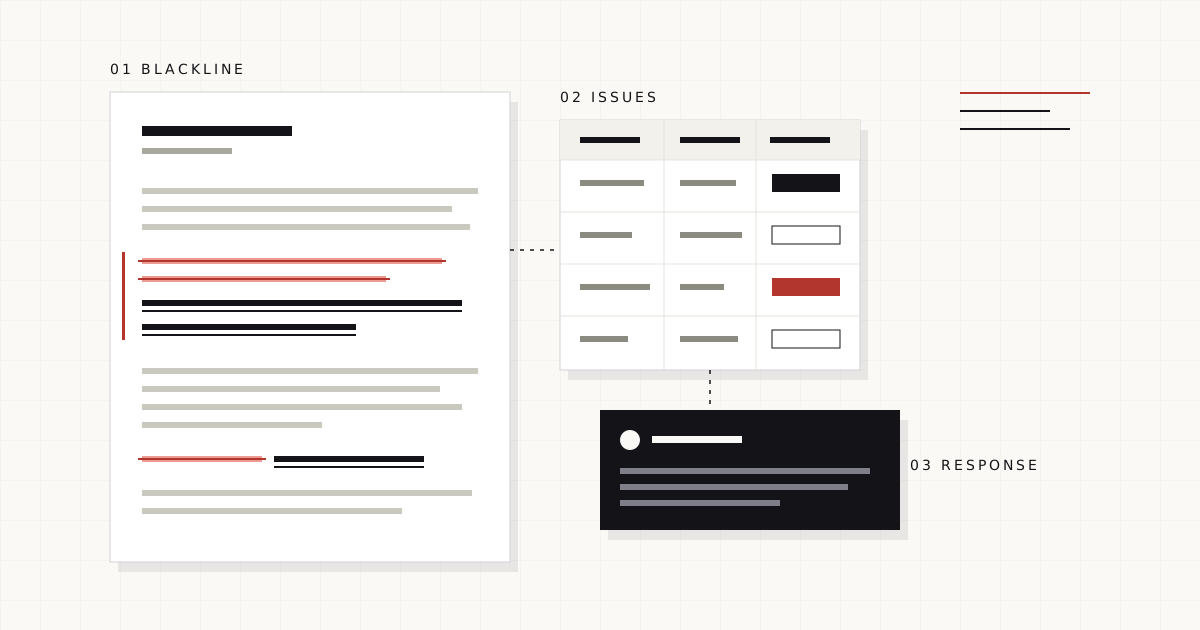
A complete review produces three things. If any one of them is missing, someone on your team is doing the rest of the work.
- The blackline. The counterparty's draft, edited, with every change visible.
- The issues table. A short list of the points that matter, each with a recommended position and a fallback.
- The counterparty response. A drafted message your team can send with the blackline, explaining the changes in commercial terms.
Each one answers a different question. The blackline answers what changed. The issues table answers why, and what we will accept. The response answers what do we say to the other side.
Artifact one: the blackline
A blackline (also called a redline or a compare) is the agreement with tracked changes: deleted text struck through, inserted text underlined. It is the deliverable the counterparty actually reads, so it has to stand on its own.
A good blackline has a few properties that are easy to check:
- Every change is visible. No silent edits, no "accepted" changes hidden in the file. The other side should be able to see exactly what moved.
- Changes are surgical. The reviewer edits the words that need to change, not the whole paragraph. Rewriting a clause from scratch when three words would do invites a fresh round of negotiation on language nobody was arguing about.
- Comments are rare and purposeful. A margin comment is for something that cannot be fixed with an edit, such as a question about the deal or a request for missing information. It is not a substitute for drafting.
- Defined terms still work. If a change adds "Affiliate," the definition exists. If it deletes a section, the cross-references are fixed.
Here is what a small, surgical change looks like.
9.2 Limitation of Liability. Except for a party's indemnification obligations and breach of Section 7 (Confidentiality), each party's total liability arising out of or related to this Agreement will not exceed the fees paid by Customer in the one (1) month or payable by Customer in the twelve (12) months preceding the event giving rise to the claim.
Notice what the reviewer did not do. They did not rewrite the clause into their preferred form. They changed the two things that mattered and left everything else alone, which makes the change easy to accept.
Artifact two: the issues table
The issues table is the most useful thing a reviewer gives you, and the most commonly skipped. It is a short table (often five to ten rows, rarely more than fifteen) listing the points that actually carry risk or cost, with a recommendation for each.
| Clause | What the draft says | Recommended position | Fallback | Your call? |
|---|---|---|---|---|
| Limitation of liability | Cap at one month of fees | Twelve months of fees | Six months, with confidentiality carved out | No, within playbook |
| Indemnity | One-way, in their favor | Mutual, limited to IP infringement and third-party claims from breach | One-way IP indemnity from us only | No, within playbook |
| Auto-renewal | Renews for one year; 90-day notice | 30-day notice | 60-day notice | No, within playbook |
| Exclusivity | We may not use other vendors | Delete | Limit to the named product line for the initial term | Yes: commercial decision |
| Payment terms | Net 15 | Net 30 | Net 30 with a late fee | No, within playbook |
Illustrative example. Positions vary by deal and by company.
The table does three jobs at once:
- It separates signal from noise. A thirty-page agreement might have sixty edits in the blackline. The table tells you which five matter.
- It shows the negotiating range. For each issue you see the opening position and how far the reviewer is prepared to move. That lets your sales lead know, before the next call, what can be conceded without coming back to anyone.
- It flags what is yours to decide. The last column is the one executives should read first. Anything marked as a business call is a decision the reviewer should not make for you.
If a provider sends a blackline with no issues table, you are left to reverse-engineer their reasoning from the edits. That is slow, and it means the person who understands the deal best (you) is working from the least information.
Artifact three: the counterparty response
The third artifact is the message that goes back to the other side with the blackline. It is usually a short email or cover note, written so that a non-lawyer on either side can follow it.
A good response does four things:
- Thanks the other side and states what is attached.
- Summarizes the main changes in plain business language, not clause numbers.
- Explains the reasoning briefly where the reason is persuasive ("our insurance and our other customer agreements are written to a twelve-month cap").
- Proposes a next step: a call, a deadline, or a request for their comments.
Thanks for sending the draft. Our comments are in the attached blackline. The main points:
Liability. We have moved the cap to twelve months of fees, which matches how the rest of our customer agreements are structured, and excluded confidentiality breaches from the cap.
Indemnity. We have made the indemnity mutual and limited it to IP infringement and third-party claims arising from a breach.
Renewal. We have shortened the non-renewal notice period to thirty days.
Everything else is clean-up. If it helps, we are glad to walk through these on a short call this week.
Without this artifact, the person who owns the relationship writes the email themselves, often by guessing at the lawyer's reasoning. With it, they review, adjust the tone if they want, and send.
What "finished work" means
A review is finished when your team can send it without doing more legal work. In practice, that means:
- The blackline is clean, internally consistent, and ready to go to the other side.
- The issues table explains every material change and states a fallback for each.
- The response is drafted and ready to send.
- Anything that needs a business decision is called out explicitly, not buried.
- An attorney has reviewed the final package before it leaves.
"Finished" does not mean "agreed." The counterparty may push back, and the next round is part of the same document's work. What it means is that each time the agreement lands on your side of the table, you get back something you can act on, not a list of questions.
What remains your decision
A reviewer can tell you what a clause means, what is market for a deal like yours, and what risk you are taking on. A reviewer should not decide questions that are really about your business. Those include:
- Commercial terms. Price, discounts, volume commitments, exclusivity, and service levels tied to revenue.
- Risk appetite above the playbook. Whether to accept an uncapped indemnity for a strategic customer, or a liability cap below your usual floor.
- Relationship calls. Whether to concede a point to close by quarter-end, or to walk away from a counterparty that will not move.
- Anything new. A clause type you have never seen, or a deal structure outside the normal pattern.
The reviewer's job is to make those decisions visible and easy to make: here is the issue, here is the risk in plain terms, here are the options. Your job is to choose.
How a playbook makes this consistent
Without a playbook, every review starts from the reviewer's judgment and memory. Two reviewers, or the same reviewer on two different days, may take different positions on the same clause. Your counterparties notice, and your agreements drift.
A playbook is a written record of your preferred positions on the clauses that recur in your agreements, with the fallbacks you will accept and the point at which an issue goes to a decision-maker. A useful playbook entry for a liability cap might say:
- Preferred: mutual cap at twelve months of fees paid or payable.
- Acceptable without escalation: six months, if confidentiality and data breaches are carved out.
- Escalate: any cap below six months, any uncapped liability on our side, or a counterparty that refuses the confidentiality carve-out.
Once that exists, three things change:
- Positions become consistent. Every reviewer starts from the same place, and your agreements converge over time instead of drifting.
- The issues table writes itself. Each issue maps to a playbook entry, so the recommendation and fallback come from a decision you already made, not a fresh judgment.
- Escalations become rare and meaningful. If something reaches your desk, it is because it falls outside what you have already approved, not because the reviewer was unsure.
A playbook also makes the work faster to check. An attorney reviewing a draft against a known set of positions can focus on what is unusual, not re-derive what is normal. This is the core of how we handle commercial contracts: your positions are written down, and every review is measured against them and against your prior deals.
A checklist for any contract review provider
Whether you use an in-house lawyer, a law firm, or a service like ours, these questions will tell you what you are actually buying:
- Will I receive a blackline, an issues table, and a drafted response, or only some of these?
- Who reviews the final work, and are they licensed in the jurisdiction that matters?
- How do you decide what to flag for my decision versus what to resolve yourself?
- Do you work from a written playbook? Can I see it and change it?
- If the counterparty comes back with another round, is that included or a new charge?
- How will I know the fee before the work starts?
If the answers are vague, the deliverable probably will be too.
Where to go from here
If you want to compare clause by clause, our companion piece on what to negotiate in NDAs, MSAs, and DPAs walks through the handful of terms that actually move on each document type. If you are thinking about the operational side, building a contract pipeline in Slack covers intake, routing, and measurement.
And if you would rather send the agreement to a lawyer who will read every line, talk to a lawyer.
Founder of Applied Legal. Former General Counsel at technology companies, software engineer, and Texas-licensed attorney who builds and runs contract pipelines. Read the full bio →
This article is general information, not legal advice, and reading it does not create an attorney-client relationship. Applied Legal is a trade name of Archuleta Partners PLLC. Responsible attorney: EJ Archuleta.