
On this page→
Ask a finance leader what legal will cost next quarter and you will usually get a range wide enough to be useless. That is not because legal work is unknowable. It is because most legal work is still sold by the hour, and the hour is a measure of effort, not of output.
For one-off matters with genuinely unpredictable scope, hourly billing can make sense. For recurring contract work, where the same kinds of agreements arrive every week, it is a poor fit. This article explains why, how a per-document fixed fee works in practice, and how to compare quotes so you know what you are actually buying.
Why hourly billing misaligns incentives for recurring work
Hourly billing has one real virtue: it adapts to uncertainty. If nobody knows how much work a matter will take, billing for time lets the work expand or shrink without renegotiating the engagement.
Recurring contracts are not that kind of work. An NDA, a customer order form, or a vendor MSA arrives with a familiar shape. The variables are known: whose paper it is, how far it departs from your positions, how many rounds the counterparty wants. In that setting, billing by the hour creates three problems.
- It rewards the wrong thing. A provider who builds a playbook, reuses positions, and gets faster is paid less for doing so. The economic incentive points away from efficiency, even when the people involved want to be efficient.
- It moves the risk to you. If a review takes longer than expected, you pay for the difference. You carry the uncertainty for work the provider has done many times and is better placed to estimate.
- It discourages asking. When every email has a meter running, people hold questions until they become problems. Contracts get signed without review because the review felt expensive, which is the most expensive outcome of all.
None of this means hourly lawyers are doing anything wrong. It means the billing unit does not match the work.
The alternative: a fee per document
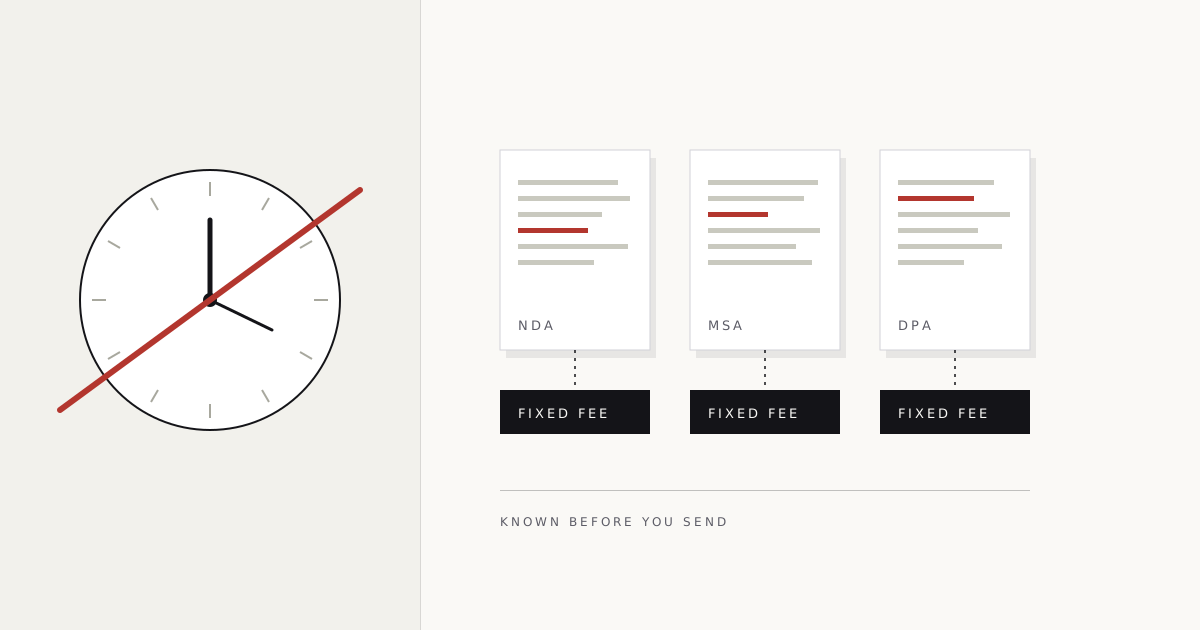
A per-document fixed fee prices the unit the business actually cares about: one agreement, taken from receipt to a finished, attorney-reviewed deliverable. You know the fee before you send the file.
The model usually has two parts.
Part one: a one-time onboarding fee
Before a provider can price documents consistently, it needs to know how you want them handled. Onboarding is where that work happens:
- Playbook build. Writing down your preferred positions, acceptable fallbacks, and escalation points for each document type you send.
- Templates. Reviewing or drafting your own-paper templates so that agreements on your paper start from a strong position.
- Intake and integration. Setting up how agreements arrive (email, Slack, a shared folder) and how finished work comes back, and connecting the tools you already use where it helps.
- Decision-makers. Agreeing who on your side approves which kinds of issues.
The onboarding fee pays for this work once. It is what makes the per-document fee possible: once your positions are written down, each review applies them rather than rediscovering them.
Part two: a fixed fee per document
After onboarding, each agreement carries a fee set in advance, typically by document type and whose paper it is. A mutual NDA on your paper is a different unit of work from a vendor's thirty-page MSA, and the fee schedule should reflect that. Within a type, the fee does not change based on how long a particular review happens to take.
What a per-document fee should include
The value of a fixed fee depends entirely on what it covers. A fee for "review" that excludes the second round of negotiation is not really fixed. At a minimum, a per-document fee should include:
- Every negotiation round on that document under the playbook. If the counterparty comes back with another redline, responding is part of the same document's work, not a new charge.
- Attorney review of every deliverable before it leaves.
- The blackline, the issues table with recommended positions and fallbacks, and a drafted response to the counterparty. (Our article on what a contract review actually includes explains each.)
- Escalation summaries for anything outside the playbook, written so a decision-maker can choose quickly.
- Routine questions about that agreement from your team while it is in progress.
What should trigger new scope
A fair fixed-fee arrangement is explicit about what is not included, so neither side is surprised. Common triggers for new scope, quoted before the work starts, include:
- A new document type that was not part of onboarding, such as a first reseller agreement or a first joint venture.
- A change to the playbook, for example after a change in your risk appetite, a new product line, or a new regulatory obligation.
- Counterparty paper beyond an agreed length, when a "standard" agreement turns out to be a very long bespoke document.
- Work outside the playbook: a negotiation that turns into a restructuring of the deal, a dispute over an existing agreement, or a question that needs a specialist.
The test of a good provider is not that new scope never happens. It is that you are told before the work is done, with a quoted fee, and you decide whether to proceed.
How to compare quotes
Comparing a fixed-fee quote with an hourly estimate, or two fixed-fee quotes with each other, is easier if you put them on the same basis. Start with your own data.
- Count last year's agreements by type and paper. Even a rough count (how many NDAs, how many customer MSAs on their paper, how many vendor agreements) gives you a volume baseline. Our contract pipeline article describes how to start capturing this going forward.
- Estimate what that volume would cost under each quote. For a fixed-fee quote, multiply each document type by its fee and add onboarding. For an hourly estimate, ask the provider for the typical hours per document type, including later rounds, and multiply.
- Normalize for what is included. If one quote includes negotiation rounds and the drafted response and another does not, the second is not comparable until you add the cost of what is missing, including the time your own team spends filling the gap.
- Look at the variance, not just the average. The value of a fixed fee is predictability. An hourly estimate with the same average but a wide spread is a different product.
- Price the internal time. Count the hours your founders, sales leads, and operators spend chasing reviews, rewriting comments into contract language, and drafting emails to the counterparty. A cheaper review that leaves that work with you may not be cheaper.
Questions to ask any fixed-fee provider
Whoever you talk to, these questions will tell you whether the fee is truly fixed and whether the work will be finished:
- What exactly is the billing unit? Is it per document, per document type, per month, or something else?
- Is onboarding a separate fee, and what does it produce? Will I own the playbook and templates afterward?
- Are later negotiation rounds on the same document included?
- What deliverables come back with each document? A blackline only, or a blackline, an issues table, and a drafted response?
- Who reviews the work before it leaves, and are they licensed in the jurisdiction that governs my agreements?
- What specifically triggers new scope, and how will I be told before it is billed?
- How do you handle a document that turns out to be much longer or more complex than expected?
- What happens to the fee schedule if my volume or document mix changes?
- Can I see a sample deliverable, with any confidential details removed?
- What happens to my files, playbook, and data if we stop working together?
A provider who answers these clearly, in writing, before you sign, is pricing the work honestly. One who cannot answer them is probably still billing by the hour, just with a different label.
A note on how lawyers may charge
Lawyers are subject to professional rules on fees in every state. In Texas, the disciplinary rules prohibit unconscionable fees and expect the basis or rate of the fee to be communicated to the client, preferably in writing, when the lawyer has not regularly represented the client. A clear fixed-fee schedule fits comfortably within those rules, and it has a practical benefit beyond compliance: both sides know the deal before the work begins.
How we price
Every engagement starts with a conversation and a written scope. Where the work is predictable, such as a defined agreement or set of agreements, a contract system build, a formation, or ongoing outside general counsel, we quote a fixed or monthly fee before we start. Disputes depend on the facts and how complex they become, so we give a fee arrangement in writing after an initial assessment and say so before the scope changes. We do not publish rates because the right fee depends on the work.
The fees page explains how this works. To get an actual number, talk to a lawyer: tell us what is happening, and you will have the scope in writing before work begins.
Founder of Applied Legal. Former General Counsel at technology companies, software engineer, and Texas-licensed attorney who builds and runs contract pipelines. Read the full bio →
This article is general information, not legal advice, and reading it does not create an attorney-client relationship. Applied Legal is a trade name of Archuleta Partners PLLC. Responsible attorney: EJ Archuleta.